When I taught Technical Analysis, the first thing I showed my students on the first 30 mins of the first class was this video of
Jim Cramer on Wall Street Confidential. For context, this was recorded before Apple released their first I-Phone, you hear Jim mention spreading rumors that AT&T didn't want the phone and as we know, AT&T has a 5 year exclusive contract with Apple. You hear Jim say things like, you can get away with this because CNBC is dying for the story and the SEC doesn't know what they are doing; he's talking about manipulating the market as fund manager and goes so far as to say, "It's a fun game" and "If you're not willing to do it, then you shouldn't be a fund manager", he also says "This isn't something I'd ever say on my show"-Mad Money. Of course he has cultivated this image of the guy who wants to help the little guy, but spent most of his career ripping off the little guy by spreading lies and manipulating the futures market. This is a MUST WATCH VIDEO.
By this time they were thoroughly disheartened and in a state of disbelief, but you have to tear down the lies to expose the truth.
The second thing I would show them as we were pretty much around the time of the financial/housing crisis was a neat little set of charts of the Home Builders around the time of the 2000 Tech Bubble/Crash.
When we examine appreciation of homes from 1968-2009 we find some interesting facts. First homes got bigger, so the median home price had to be adjusted to a per square foot price and then you had to add in the rate of inflation, what you come up with is an annual increase of 3.7% with inflation over the period averaging 4.5%, so home appreciation was actually negative as it didn't keep up with the average inflation over the period.
We all know that there were booms and busts, but this i all averaged in for our purposes.
Now lets take a look at a Home Builder, HOV.

Here's the NASDAQ 100 in red, which did very well during the Tech Bubble because of it's weight in tech companies. In green is HOV. This is a period I remember very well. Everyone thought the next bull market would be tech driven, a kind of tech 2.0, however it is rare to see the leader of one bull market become the leader of the next, I can't think of one example. During the period from the top of the Tech bubble to the start of the 2003 Bull market, the NASDAQ 100 lost 83%, while HOV gained 400%! Considering the average appreciation of home prices and having just come out of a technology revolution, who would have ever guessed housing would lead the next bull market? It is a pretty well known fact that the economy did well simply because people were seeing their homes appreciate, taking out a HELOC and spending money on everything they wanted from plasma TV's to RV's, boats, second homes, etc. The Housing rally was a huge part of general support for the economy, you yourself may have had this experience. The question remains, how did smart money know to buy home builders? Did they know? The answer is yes.

Here's a long term 3C chart of HOV during 2000 while technology stocks were being slaughtered. That would be an insane amount of accumulation as it is a leading positive divergence on a 3 day chart-remember, the longer the chart, the bigger the accumulation and following trend.
You can see before that, in 1998-99, HOV was trading in line, no accumulation, but come 2000, smart money was taking money out of tech and buying up the home builders. Note the flat trading range in the red box, this is very typical of accumulation and distribution. They want to buy at low average price, so they keep prices flat, they don't allow any substantial rallies and they do this very quietly, typically on low volume as to not raise any suspicions. This 2 day chart shows accumulation started in Q3 of 1999 and throughout 2000, while tech imploded.
Here's what happened after accumulation. HOV accumulated through 2001 and part of 2002, in our market stages, this is stage 1, a base. Around late 2002, HOV entered stage 2 which is called mark up, this is when traders start to take notice and jump on the bandwagon. As the green arrow points out, stage 2 was a confirmed uptrend with 3C moving higher with price.
Here' a longer view, 2000-2002 accumulation-a HUGE POSITION, 2002 mark up as prices lifted off out of the range. By 2004 distribution started, but traders didn't know that, they were seeing the housing bubble gain momentum and buying home builders, this is exactly the kind of demand Smart money needs to sell their massive long position, a little at a time in to rising prices and demand. By 2005, they were nearly done and home builders started to top, distribution is stage 3/top. Note how distribution got heavier into 2004-2005. By this time HOV climbed almost 2400%!
Home Builders topped out in 2005, 2 years before the market and started stage 4-decline. You'll notice another little positive divergence from 2008-2009 as the market (S&P-500 in red) continued to decline.

Notice the volume during accumulation in 2000, they raised no suspicions, the last thing they needed was traders realizing this was the next bull market and driving pricesthis was the distribution area. Finally a parabolic rise in prices, this is almost always a sign of the end of a trend, but traders chase them all the time just to see a parabolic decline just as fat quickly wipe out their gains as they are emotionally attached to the trade by this point after having made so much money. This is part of the psychology of bubbles I've studies back to the 1600's and the Dutch tulip Craze. Every Bubble comes with the mandatory mantra, "This time it's different". Whether it was different because of a rare disease that struck tulip and caused beautiful colorations, or the Tech bubble that would revolutionize the way we do everything in life. I was a late bloomer and bought my first cell phone around 1997 when my father got sick and I wanted to be available any time. However, the mantra was in full force during the Tech Bubble and then real estate, "It's your biggest investment", the lie, "Real Estate never loses value"; her in South Florida homes doubled in prices in 2 years in our area, "You won't be able to afford a home if you don't buy now, they'll just keep rising in price" and my Florida favorite, "They have used all the land in South Florida, there's no more land, homes are going to keep rising". No offense to house wives who work tirelessly for their families, but when every barbecue you go to the subject is how everyone there is a real estate speculator with 2 or 3 mortgages and 2-3 homes (only 1 of which is their home, the rest are projects to flip) and House wives start flipping homes, you know the end is near. I had friends, a married couple, one was a stay at home mom/home schooler, the husband was in computers; they had 4 houses at once, they kept refinancing and buying more. They made about $75-$90k per home and begged me to take out a Heloc and buy more homes wit them, it wasn't for me even though my father was a general contractor for 35 years and my mother a real estate agent for a time. I had my own business in custom furniture and worked as a manager for a high-end custom interiors/custom furniture builder and travelled to New York, Philadelphia and Bermuda on multi million dollar jobs. Nearly every piece of furniture I have, I built so I had the know how. I knew since 2003 when we were looking for a home and went on vacation to Europe for 2 weeks and saw every home we looked at in the last 6 months, most of which had not sold, had jumped in price by 30% in those 2 weeks! The home we bought in late 2003 went from $205,000 to $475,000 by 2005/2006. We had offers of $350k by developers who just wanted to bulldoze our house and build a McMansion.

Here's one last Hurrah for home builders when it seemed the March 2009 stimulus had high hopes. HOV accumulated again and gained almost 900% in 8 months.
So the fundamental question dealing with the reality of out markets is how did Smart Money know that housing, which could barely keep up with inflation would be the next Bull Market. Consider how much accumulation they put in, they had a real sense of surety about this as their commitment was enormous.
I don't know if we will know for sure, but some have speculated that investment banks took a lot of losses on IPOs such as E-Toys, the now defunct dot com that was selling over $300 a share with no earnings and a dismal Christmas season as they could not deliver the toys purchased on line by Christmas.
Some say and I believe this, that Greenspan was going to help these investment banks make their money back by telling them what Fed policy would be in advance and that housing would be the beneficiary of regulatory failures and economic policy. How else would they know they had a sure thing on their hands?
Consider my post, Operation Twist, posted 2 hours before the FOMC announced Operation Twist on September 21.
Think back to all of the opinions and speculation that the "FAD" would be buying the 10 year, maybe the 12-15, some said 7 years, the consensus was the 10 year though as the 10 year sets the rate for most consumer loans including housing, which would presumably help housing. I may have heard someone speculate about the 20 year, but I don't recall any speculation about the 30 year. My post showed massive accumulation/confirmation, something I said was very rare at the time, all concentrated on the 20+ year Treasuries. I said, "If the FAD does Operation Twist, they will focus on the long end of the curve", 2 hours later, to every talking head's total shock, it was confirmed, the bulk of purchases would be in the 20-30 year T's.

The FAD meets on Friday in an emergency meeting with Primary Dealers like Goldman Sachs to, "Ask their opinion of what to do if the debt ceiling isn't raised" Does that sound believable to you? The next market day, the market starts its fall in earnest, even though the debt ceiling is passed and widely expected to cause the market to rally.
Look at how TLT gained as the market fell, could the Primary Dealers/Wall Street investment banks have been selling equities to accumulate 20-30 year Treasuries knowing the FAD would be buying them?
The day of the FAD/PD meeting and TLT's parabolic rise.
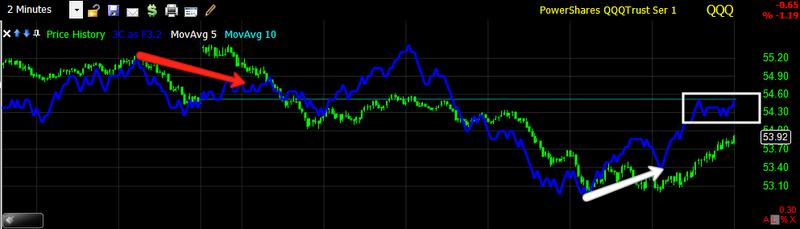
The day of the meeting and strong 3C leading accumulation, only now s it seeing distribution
And accumulation in TLT days and mere hours before the announcement.
I've seen a lot when it comes to FAD announcements. Not to long ago a nice uptrend started seeing huge distribution on an FOMC day, we sold and got out, not knowing what was going on, but seeing the distribution as if it was a panic over several hours, the FAD made an announcement and the market crashed.
You be the judge, but the longer you have been a member of WOWS, the more of this stuff you have seen with your own eyes.




 | Theme by Thur


